
Pruning
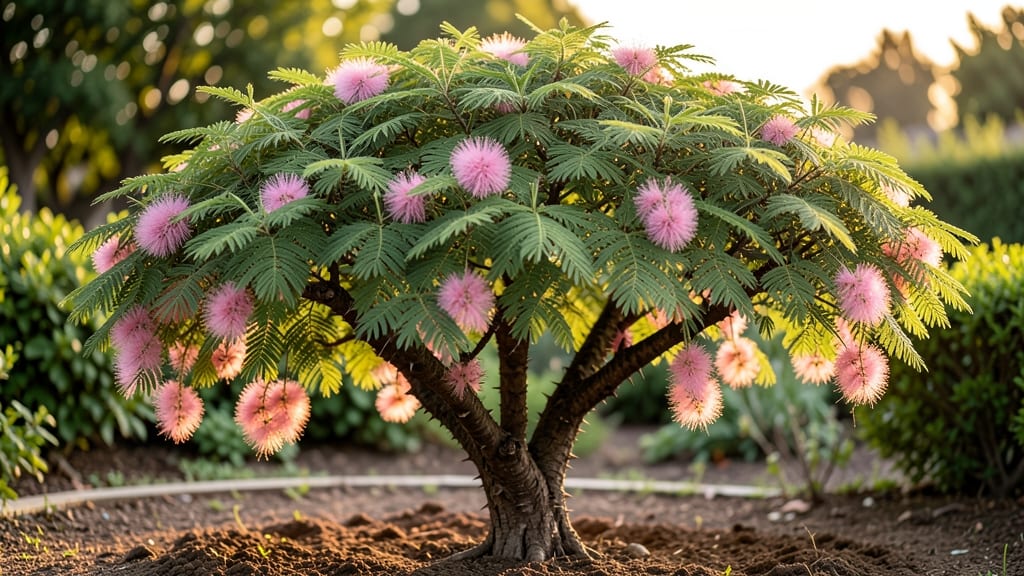
Yes, mimosa trees have thorns, especially the Albizia julibrissin (silver mimosa), which develops sharp, pointed clusters along its branches. Different species exhibit varying sharpness—some like mimosa pudica feature softer, hair-like spines instead. Always use protective gloves when handling these trees to prevent cuts.
Mimosa trees develop thorns primarily as a natural defense mechanism against herbivores and environmental stress. 🌿 The Albizia julibrissin, for example, produces dense clusters of sharp thorns that can measure up to 1 inch long, while other varieties like Acacia hybrids may have thinner, more flexible spines.
These differences aren't just about sharpness—they also affect how the tree grows and responds to pruning. When trimming, focus on removing thorny branches during late winter or early spring, as this minimizes stress on the tree and reduces the risk of infection.
For safety, I recommend wearing heavy-duty gardening gloves and using long-handled pruners to avoid accidental punctures. After pruning, apply a wound sealant to larger cuts to promote faster healing and discourage thorn regrowth in that area.
The key is balancing maintenance with the tree's natural defenses—over-pruning can actually encourage more aggressive thorn production as the tree compensates for perceived threats.
💡 In This Article
- Mimosa Tree Thorn Types by Species: Sharpness and Growth Patterns
- Safe Pruning Techniques to Minimize Thorn-Related Injuries
Mimosa tree thorn types by species: sharpness and growth patterns
The thorns on mimosa trees serve a dual purpose: defense and photosynthesis. The Albizia julibrissin (silver mimosa) produces 1- to 2-inch-long, triangular thorns that grow in dense clusters along branches. These thorns are sharp enough to puncture gloves, making them a hazard during pruning.
Under a microscope, you’d see their surface is slightly ridged, which increases their grip on anything that brushes against them. 🌿
In contrast, the mimosa pudica (sensitive plant) has thorns that are more like fine, hair-like spines—barely noticeable unless you run your fingers along the stems. These spines are softer but still capable of causing irritation.
The difference lies in their evolutionary purpose: Albizia thorns deter large animals, while mimosa pudica thorns protect against insects. Even within the Albizia genus, younger branches tend to have fewer thorns, but as branches mature, the thorn clusters become denser and sharper.
Another key factor is the tree’s growth rate. Fast-growing mimosa trees, like the Albizia julibrissin, develop thorns more aggressively in response to stress—whether from drought, poor soil, or physical damage. This is why over-pruned trees often sprout thicker, sharper thorns as a survival mechanism.
The thorns also play a role in photosynthesis; some species, like Acacia hybrids, have modified thorns called "phyllodes" that perform photosynthesis instead of leaves, which explains why they’re less thorny but still prickly.
If you’re comparing mimosa thorns to other trees, they’re sharper than roses (which have curved, hollow thorns) but not as aggressive as blackberry brambles. The angle of mimosa thorns—pointing outward and downward—makes them particularly effective at snagging clothing or skin.
This design is a trade-off: while it protects the tree, it also makes maintenance a challenge for gardeners. 🌱
For those curious about the science, thorns are modified stems or leaves that evolved independently in different plant families. In mimosa trees, they’re actually modified branches called "stipular thorns," which grow from the leaf axils.
This means they’re not just random spikes—they’re part of the tree’s vascular system, connected to the same nutrients and water pathways as the rest of the plant.
Understanding these differences helps explain why some mimosa varieties are safer to handle than others. For example, the Acacia koa has thorns that are less sharp but more numerous, while the Albizia lebbeck (another mimosa relative) produces thorns that are thicker and more woody.
Knowing your species can mean the difference between a smooth pruning session and a trip to the emergency room. ✨