
Propagation
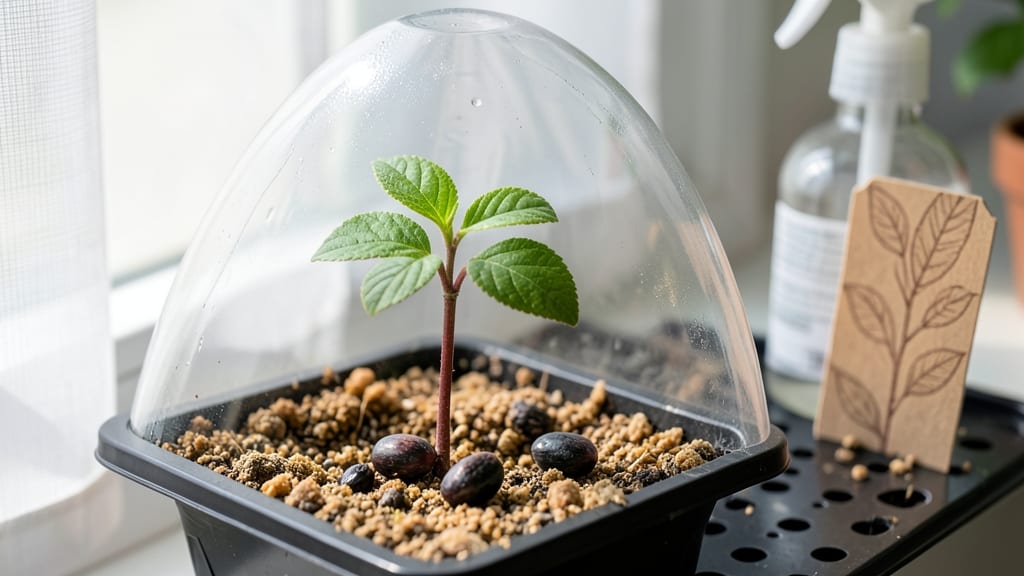
You can grow a persimmon tree from seed, but the process demands significant patience and precise conditions: seeds must undergo 60-90 days of cold stratification before germination, with survival rates rarely exceeding 50% due to genetic variability and slow early growth.
While the journey from seed to sapling is challenging, the unpredictability stems from persimmon seeds' natural dormancy cycle. 🌱 Unlike many fruit trees, these seeds require a cold period to break dormancy—mimicking winter conditions—before they'll even attempt sprouting.
I've found that maintaining consistent moisture during stratification (around 35-40°F) is critical, as fluctuations can trigger premature germination or complete failure. Even with perfect care, only about half of seeds will sprout, and those that do often grow at a snail's pace in their first year.
What's fascinating is how the genetic lottery plays out: some seeds produce trees that bear fruit in 5-7 years, while others may never fruit at all. This variability is why many gardeners prefer grafting established varieties onto seedling rootstocks—a more reliable approach for predictable harvests.
Still, the reward of watching a tree you nurtured from seed mature can make the gamble worthwhile.
💡 In This Article
- Persimmon Seed Germination Process Explained
- Tips for Maximizing Persimmon Seedling Survival
Persimmon seed germination process explained
The persimmon seed's journey to life begins with a critical biological process called cold stratification, where seeds mimic natural winter conditions to break dormancy. Unlike many plants that germinate quickly, persimmons need 60-90 days at temperatures between 35-40°F to trigger root growth.
This cold period softens the seed coat and activates enzymes that prepare the embryo for sprouting. Without this step, seeds may remain dormant indefinitely, even with ideal warmth and moisture.
During stratification, the seed absorbs moisture but doesn't yet germinate—think of it as a biological "reset button." The root (radicle) emerges first, growing downward into the soil while the shoot remains curled inside the seed. This stage can take 2-4 weeks at consistent cold temperatures.
What's surprising is how sensitive this process is: even a brief warm spell can trick the seed into premature germination, often resulting in weak, leggy seedlings that struggle to survive. 🌱
The germination window itself is narrow but dramatic. Once temperatures rise above 60°F, the shoot breaks through the soil in 7-14 days, unfurling into the first true leaves. These early leaves are delicate and prone to damage from temperature swings or poor air circulation.
The seedling's root system develops slowly—often taking 3-6 months to establish a sturdy taproot—making it vulnerable to transplant shock later.
Not all seeds respond equally to stratification. Some varieties, like the Asian persimmon (Diospyros kaki), have higher germination rates (up to 60%) when properly stratified, while American persimmons (Diospyros virginiana) often hover around 30-40%.
The discrepancy stems from genetic differences in seed coat thickness and internal dormancy mechanisms. Even with perfect conditions, some seeds may simply "give up" and never sprout, a frustrating but common reality for seed growers.
One fascinating detail is how light affects germination. Unlike many trees, persimmon seeds don't require light to sprout—they're skotomorphogenic, meaning they'll germinate in complete darkness.
However, once the shoot emerges, it needs 6-8 hours of direct sunlight daily to prevent etiolation (the leggy, weak growth that occurs when plants stretch toward light). This dual requirement explains why many failed germination attempts happen in indoor setups with artificial light.
Understanding this process helps explain why so many seed-grown persimmons fail: the combination of precise temperature control, moisture balance, and genetic unpredictability creates a high-stakes experiment. Even with perfect stratification, only about half of seeds will germinate, and of those, only a fraction will survive to maturity.
The patience required—waiting months for a single seedling to emerge—is what makes this propagation method so rewarding for dedicated gardeners.