
Plants
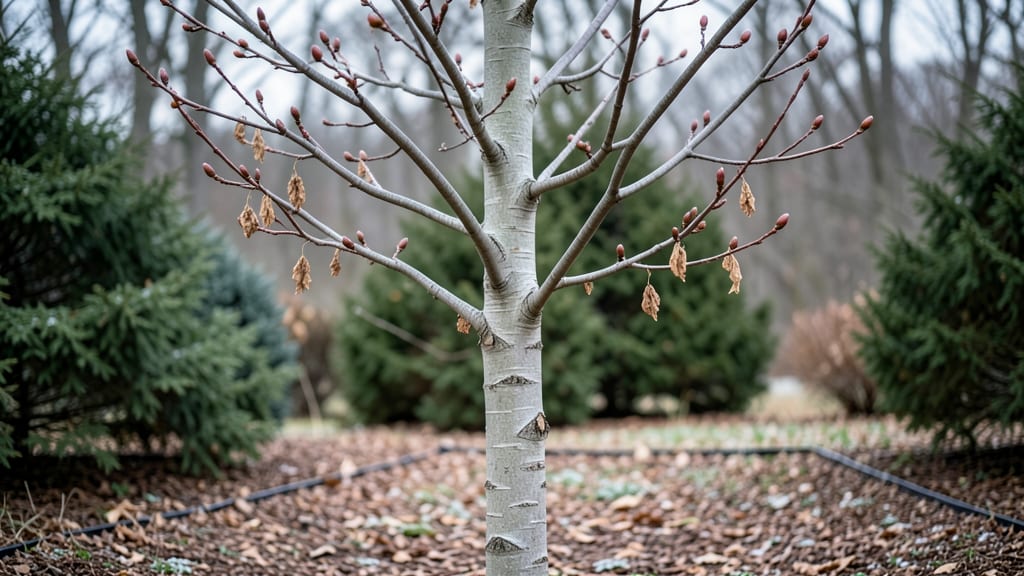
A dogwood tree in winter looks like a layered dessert with its smooth, gray-brown bark that peels in thin strips and horizontal lenticel lines. The branches zigzag with small, opposite buds, creating a delicate, tiered silhouette.
A dogwood tree's winter appearance is all about its distinctive bark texture and branch architecture.
The smooth, grayish-brown trunk often develops subtle horizontal lines called lenticels, which give it a striped look as it peels in thin layers. 🌳 These visual cues help differentiate it from other winter trees—unlike maples with their rough bark or cherries with their smoother, darker trunks.
The zigzagging branches with tiny, opposite buds create that signature "layered cake" shape that makes dogwoods instantly recognizable even when bare.
What's fascinating is how the bark's exfoliation pattern changes with age. Younger trees have smoother bark, while mature specimens develop more pronounced peeling, adding to their winter charm. This unique combination of bark and branch structure makes dogwood trees stand out in any dormant landscape.
💡 In This Article
- Identifying Dogwood Bark and Branch Patterns
- Winter Dogwood Tree Comparison Guide
Identifying dogwood bark and branch patterns
The dogwood's winter bark is one of its most striking features, starting as smooth and gray-brown when young but gradually developing a distinctive pattern as it matures. Those horizontal lenticels—tiny, raised pores—run parallel to the trunk, spaced about 1/4 to 1/2 inch apart, creating a subtle striped effect.
These aren't just decorative; they're the tree's breathing pores that regulate gas exchange, becoming more prominent as the bark peels in thin, papery strips. 🌿 The peeling happens naturally as the tree grows, revealing fresh bark underneath that maintains the same smooth texture.
What truly sets dogwood branches apart is their zigzagging pattern, created by alternating branch segments that grow at roughly 45-degree angles to the trunk. This isn't random—it's an adaptation that helps the tree resist wind damage by distributing weight more evenly.
The small, opposite buds (typically 1/8 inch long) appear in pairs along these branches, positioned directly across from each other, which is a key distinguishing feature when compared to other trees where buds might be alternate or clustered.
Here's where things get interesting: the bark's exfoliation pattern changes dramatically with age. Young dogwoods (under 10 years) have nearly flawless bark, while mature specimens develop 1-3 inch wide strips that peel back to reveal lighter-colored underlayers. This creates a textured, almost layered appearance that's completely unique.
The branches also become more pronounced with age, developing a wavy, tiered silhouette that makes the tree look like it's been carefully pruned into a natural work of art.
To really understand why this matters, consider how these features work together: the smooth bark reduces water loss during winter, while the lenticels allow necessary gas exchange. The zigzag branches help prevent snow accumulation from breaking limbs, and the opposite buds ensure symmetrical growth patterns.
This combination of functional adaptations creates the dogwood's signature winter look that's both beautiful and highly practical. 🌳
What most people overlook is how these patterns vary between species. For example, flowering dogwoods (Cornus florida) have more pronounced exfoliation than Pacific dogwoods (Cornus nuttallii), whose bark peels in narrower strips.
The branch angles also differ slightly—flowering dogwoods tend to have more pronounced zigzags, while other species might show a more gradual curve. These subtle differences are what make winter tree identification such a fascinating study.