
Plants
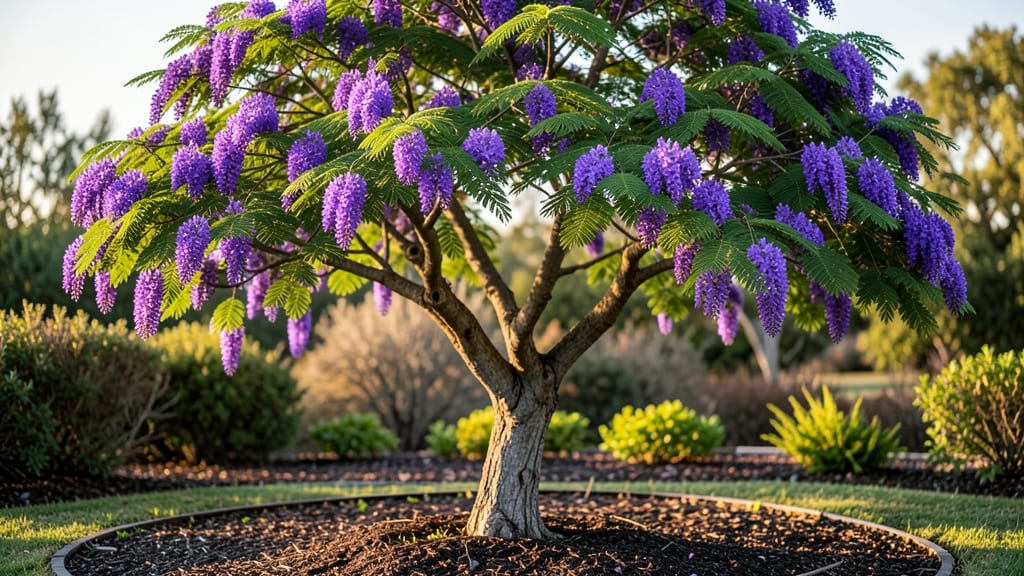
A jacaranda tree looks like a tropical dream with its delicate, fern-like foliage made of 10-20 pairs of leaflets, silvery-gray bark, and dramatic cascades of lavender-blue trumpet flowers that burst into bloom each spring. The tree's wide-spreading canopy creates a graceful, rounded silhouette with gently drooping branches.
A jacaranda tree's most distinctive features are its compound leaves that resemble lacy ferns, perfect for creating shade while maintaining an airy appearance. 🌿 The bark develops a smooth, almost metallic sheen as the tree matures, while the flowers form dense, fragrant clusters that can reach up to 12 inches long—transforming neighborhoods into purple clouds during peak bloom.
What makes this tree so recognizable is how all these elements combine: the soft foliage, the elegant branching pattern, and the dramatic floral display that lasts for weeks.
These trees thrive in warm climates but can adapt to mild winters, making them popular in Mediterranean and subtropical regions. The spring blooms are particularly spectacular, often drawing crowds to parks and gardens where jacarandas become the star attraction.
Their unique combination of textures and colors makes them instantly identifiable, even from a distance.
💡 In This Article
- Identifying Jacaranda Tree Leaves and Bark
- Jacaranda Flower Characteristics and Blooming Seasons
Identifying jacaranda tree leaves and bark
The jacaranda's leaves are compound and pinnate, meaning each leaf consists of multiple leaflets arranged along a central stem.
These leaflets typically number between 10-20 pairs, creating that signature fern-like appearance. 🌿 Each leaflet measures about 1-2 inches long with a smooth, slightly waxy texture that helps reduce water loss in their native dry climates.
The arrangement creates an intricate, almost lace-like pattern when viewed from above, which is a key identifier when distinguishing jacarandas from similar trees like the royal poinciana, whose leaves are more palmate (fan-shaped) with fewer, broader leaflets.
The bark of a mature jacaranda develops a distinctive smooth, almost metallic sheen that's typically grayish-brown. Younger trees have rougher bark that gradually becomes smoother as they age, a process that takes about 10-15 years.
This bark texture helps the tree regulate temperature and moisture, which is crucial for their survival in hot climates. The contrast between the silvery bark and the deep green foliage creates a striking visual effect that's immediately noticeable from a distance.
Seasonal changes affect both leaves and bark. In cooler months, jacarandas may shed some leaves to conserve energy, though they're generally evergreen in warmer climates. The bark's smoothness remains consistent year-round, but may develop slight cracks in extremely dry conditions.
This seasonal adaptation helps the tree maintain its distinctive appearance while conserving resources during less favorable weather.
To distinguish jacarandas from similar trees, focus on these three key features: the compound leaf structure with 10-20 leaflet pairs, the smooth gray bark, and the graceful branching pattern.
The royal poinciana, for example, has fewer leaflets arranged in a fan shape, while the mimosa tree has bipinnate leaves (leaflets on leaflets). These differences become especially apparent when examining the tree from multiple angles.
The jacaranda's leaf arrangement isn't just decorative—it's an evolutionary adaptation. The compound structure increases surface area for photosynthesis while reducing water loss through transpiration. This design allows the tree to thrive in dry conditions while maintaining its lush appearance.
The combination of these botanical features makes identification straightforward once you know what to look for.