
Pruning
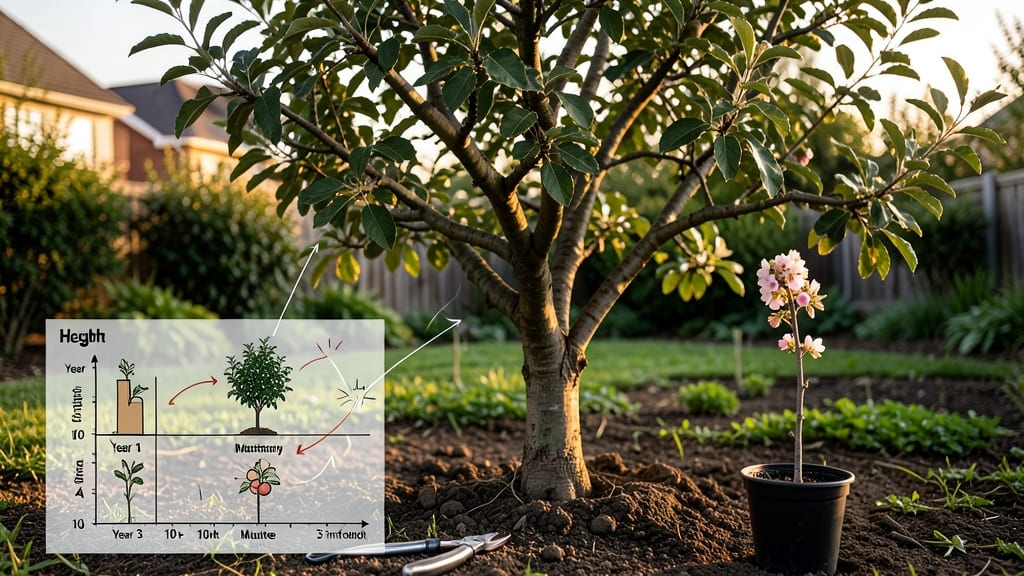
Your apple tree growth chart won’t magically show overnight—it follows a predictable growth timeline that varies by variety, but knowing the stages helps you plan for pruning, fruiting, and everything in between. 🌱 I’ve tracked my own trees for years, and the first five years are the most critical for setting up strong structure and early fruit production.
The early years focus on height: a young tree might grow 6-12 inches per year in its first two years, then 12-24 inches annually until it reaches maturity (typically 15-25 feet for standard varieties). Dwarf varieties stay under 8 feet, making them perfect for small spaces.
Pruning in late winter shapes the tree while it’s dormant, and by year 3, you’ll start seeing those first blossoms—though fruit may not appear until year 4 or 5.
By year 5, your tree should be in full swing: flowering in spring, setting fruit, and needing regular thinning to avoid overcrowding. The real payoff comes when you harvest your first full crop—5-10 years in, depending on the variety.
Every season after that, with proper care, you’ll get heavier yields and fewer pests.
This chart isn’t just about height—it’s about seasonal milestones like when to prune, how to support young trunks, and what to watch for in terms of pests. Whether you’re planting a seedling or a young sapling, timing is everything. Let’s break down what to expect each year.
📚 In This Guide
- What you need
- Instructions
- Tips and common mistakes
- Wrapping up and next steps
What you need
- ● Apple Tree Seedling or Sapling: Choose a variety-specific rootstock (e.g., M.9 for dwarf, MM.106 for semi-dwarf, or seedling for standard-sized trees).
- ● Age: 1- to 3-year-old bare-root or potted trees for best establishment.
- ● Soil Test Kit: To analyze pH (ideal: 6.0–7.0) and nutrient levels before planting.
- ● High-Quality Soil: 60% topsoil (well-draining, rich in organic matter).
- ● 30% compost (aged, weed-free).
- ● 10% perlite or sand (for drainage, especially in clay-heavy soils).
- ● Fertilizer: Balanced 10-10-10 (for young trees) or organic options like fish emulsion or compost tea.
- ● Slow-release granules (e.g., Osmoote) for sustained growth.
- ● Mulch: 3–4 inches of wood chips, straw, or shredded bark (keep 3–4 inches away from the trunk to prevent rot).
- ● Watering Supplies: Drip irrigation system or a 5-gallon watering can with a long spout.
- ○ Moisture meter (optional but helpful for tracking soil hydration).
- ● Pruning Tools: Bypass pruners (sharp, bypass-style for clean cuts).
- ● Loppers (for branches ½–2 inches thick).
- ● Hand saw (for thicker branches, 2+ inches).
- ○ Pruning sealant (optional, for wounds > ½ inch).
- ● Support Stakes: 2–3 wooden or metal stakes (5–6 feet tall) + tree ties (for young trees).
- ● Pest/Disease Control: Neem oil or horticultural oil (for aphids, mites).
- ● Copper fungicide (preventative for apple scab, powdery mildew).
- ● Sticky traps (for codling moths).
- ● Growth Chart: Printable or digital variety-specific apple tree growth chart (like the one in this article!) to track height/width yearly.
- ● Tree Training Kit: Spreaders or flexible wires for espalier training (if shaping your tree).
- ● Soil Amendments: Lime (if soil is acidic) or gypsum (for compacted clay).
- ● Weather Monitoring: Thermometer/hygrometer to track chill hours (critical for flowering).
How to track your apple tree's growth by variety
Here's the straightforward way to predict and monitor your tree's height each year—no guesswork involved.
📏 Step 1: Identify Your Apple Variety's Growth Rate Category
Apple trees fall into three main growth categories: standard, semi-dwarf, and dwarf. Standard varieties grow 25-40 feet tall at maturity, semi-dwarfs reach 15-20 feet, and dwarfs top out at 8-12 feet. Check your tree's label or nursery notes—this determines your entire growth timeline.
I always verify with the nursery before planting because even within categories, some varieties grow faster. For example, 'Honeycrisp' (standard) may reach 30 feet by year 10, while 'Granny Smith' (semi-dwarf) typically hits 18 feet in the same timeframe. Write down your variety and category—you'll reference this constantly.
⏰ Step 2: Map Your Tree's Yearly Height Milestones
Use this general chart as your baseline, then adjust by ±2 feet based on your climate and growing conditions. In year 1, all varieties grow 1-2 feet as they establish roots. By year 3, expect 6-10 feet of growth—this is when branches start forming. Semi-dwarfs and dwarfs surge in height during years 4-6, while standards grow steadily.
Here's the key: dwarf varieties often reach 50% of their mature height by year 5, while standards take 10+ years. I mark my calendar for spring each year to measure—spring growth is most predictable. Use a measuring tape (not a ruler) and record height from the base of the trunk to the highest branch tip.
🌱 Step 3: Adjust for Climate and Care Factors
Your tree's actual growth will vary based on sunlight, water, and soil quality. Trees in full sun (6+ hours daily) grow 10-20% faster than those in partial shade. If your tree gets less than 6 hours of sun, subtract 1-2 feet from each year's expected growth. Similarly, well-drained, fertile soil adds 3-5 feet to mature height compared to poor soil.
Watering matters too: deep watering (1-2 inches per week) during dry spells prevents stunted growth. I set a rain gauge near my trees—when it reads less than 1 inch, I water deeply. Overwatering causes root rot, which slows height growth by 30% or more. Watch for yellowing leaves or mushy stems as red flags.
✂️ Step 4: Prune Strategically to Shape Growth
Pruning in late winter (before buds swell) encourages upward growth. For standard varieties, remove only dead or crossing branches—let them grow naturally. Semi-dwarfs and dwarfs benefit from light pruning (20-30% of branches) each year to maintain shape. Never prune more than 25% of the canopy in one season, or you'll stunt height growth.
I always prune just above a outward-facing bud to encourage new growth. Use sterilized pruners to prevent disease. After pruning, your tree may grow 1-2 feet less that year as it recovers, but future years compensate. Label your pruning cuts with the year—it helps track long-term progress.
📊 Step 5: Create Your Custom Growth Chart
Transfer your measurements to a simple chart with columns for years 1-10 and rows for height in feet. Plot your tree's actual growth alongside the variety's expected range. For example, if your 'Fuji' (semi-dwarf) hits 12 feet by year 4 instead of the expected 8-10 feet, note whether it received extra sunlight or fertilizer—this reveals what works in your climate.
Update the chart annually in spring before new growth begins. I use a dry-erase board hung near my trees so I can see progress at a glance. Over time, you'll spot patterns—like my 'Gala' dwarf always grows 1 foot less in years with below-average rainfall. This becomes your tree's "growth fingerprint."
Tips & tricks for perfect apple tree growth tracking
Tracking your apple tree's growth doesn't have to be complicated—just strategic. These practical tips will help you get the most accurate measurements and predictions every year.
Variety-Specific Research: Don't rely solely on the general category (standard, semi-dwarf, or dwarf) when researching your tree's growth. Some varieties within the same category can vary significantly. For example, 'Arctic Sweet' dwarfs typically reach only 6-8 feet, while 'Gala' dwarfs can grow up to 12 feet. I always cross-reference with university extension services or trusted orchard websites to find variety-specific growth charts. This level of detail makes all the difference in accuracy.
Spring Measuring Timing: The instructions mention measuring in spring, but there's a specific window that works best: aim for early to mid-April in most climates. This is when trees begin active growth but haven't yet reached their peak height for the year. I mark my calendar for the first week of April and always measure before any new leaves emerge. If you miss this window, wait until after the first flush of new growth to get a more accurate baseline for the year's growth.
Digital Documentation: While a dry-erase board works great, I've found that digital documentation creates a searchable record that lasts forever. Take annual photos from the same angle each year and upload them to a cloud service with your measurements. This creates a visual timeline that's especially helpful when comparing growth patterns over multiple years. You can also use apps like PlantNet or iNaturalist to identify any unexpected growth changes or potential issues.
Climate Adjustments: The ±2-foot adjustment mentioned for climate is a good starting point, but you can get more precise. Keep a simple climate journal noting average temperatures, rainfall, and sunlight hours each year. For example, if your area had an unusually warm winter, you might see 1-2 extra feet of growth compared to the baseline. I've noticed that in years with average temperatures above 50°F during the growing season, my trees consistently exceed their expected growth by about 10%. This helps you fine-tune your predictions year after year.
Pro Tips for Apple Tree Growth Chart
- Tracking your apple tree's growth doesn't have to be complicated—just strategic.
- Variety-Specific Research: Don't rely solely on the general category (standard, semi-dwarf, or dwarf) when researching your tree's growth.
- Spring Measuring Timing: The instructions mention measuring in spring, but there's a specific window that works best: aim for early to mid-April in most climates.
Frequently asked questions
Got questions about tracking your apple tree’s growth? You’re not alone! Here are answers to the most common queries—whether you’re a first-time grower or a seasoned orchard keeper.
How do I know if my apple tree is growing at a healthy rate?
Compare your tree’s height and spread to a variety-specific growth chart. Most standard varieties grow 12–24 inches per year in their first 5 years. If growth stalls, check for pests, poor soil, or over-pruning. Pro tip: Measure annually in early spring before buds swell for the most accurate baseline!
Can I prune my apple tree at any time of year?
Timing matters! For summer-bearing varieties, prune in late winter or early spring (before buds break) to shape the tree and remove dead wood. Avoid heavy pruning in fall—it can stress the tree and invite disease. Exception: Light pruning to improve airflow can happen in summer after harvest.
Will my dwarf apple tree stay small forever?
Dwarf trees (like ‘Columnar’ or ‘Semi-Dwarf’) are genetically smaller but still grow—just 6–12 feet tall (vs. 20+ feet for standard varieties). With proper pruning and spacing (10–15 feet apart), they’ll stay manageable. Fun fact: Dwarf trees fruit faster (3–5 years vs. 5–7) but need consistent care to avoid overcrowding!
Why are the leaves yellowing or curling on my young apple tree?
Yellowing leaves often signal nutrient deficiencies (like iron or nitrogen) or pests (aphids, mites). Check the undersides of leaves for tiny bugs. Overwatering or compacted soil can also cause stress. Quick fix: Test soil pH (ideal: 6.0–7.0) and amend with compost. For pests, spray with neem oil or insecticidal soap.
Can I grow an apple tree from a store-bought apple?
Technically yes, but it’s not recommended for fruit production. Seeds from grocery-store apples often grow into wild, unpredictable trees with poor-quality fruit. For reliable varieties, buy a grafted sapling from a nursery. Bonus tip: If you’re curious, try it as a fun experiment—but plant it far from your orchard!
Wrapping up and next steps
Understanding your apple tree’s growth timeline—whether it’s a dwarf Honeycrisp or a towering Granny Smith—helps you nurture it with confidence. From sapling to fruit-bearing maturity, each variety follows its own pace, but patience and care are your best tools for a thriving orchard.
Now that you’re equipped with variety-specific milestones, take the next step: sketch a simple growth plan for your tree, noting key pruning windows and seasonal tasks to keep it healthy and productive.
🌱 Pro tip: Celebrate small wins—like that first blossom or harvest—and enjoy the journey! Your apple tree’s story is just beginning. 🍏