
Trees
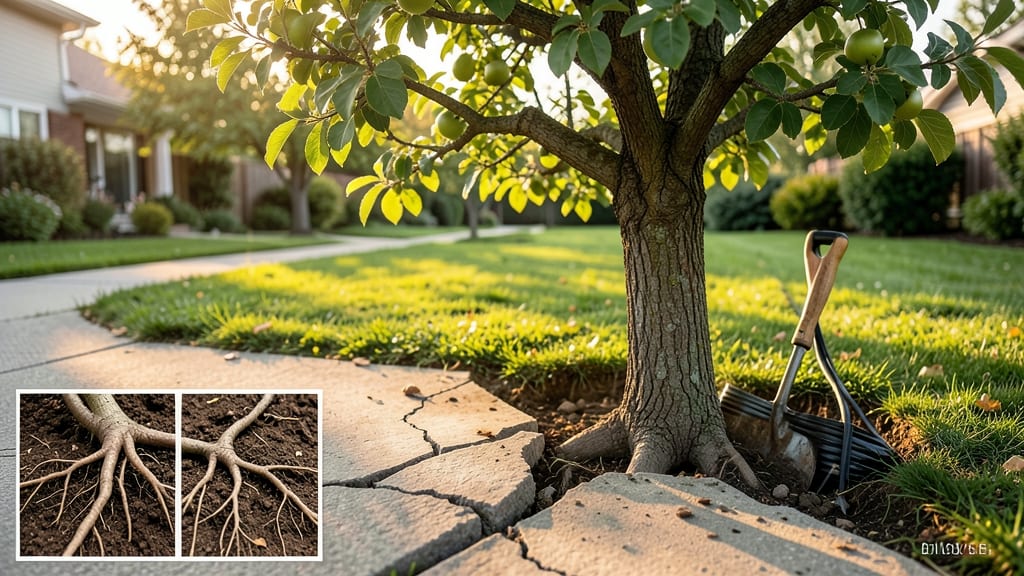
Apple tree roots do cause damage when planted too close to structures, spreading aggressively up to 30-50 feet wide and 6-8 feet deep. This aggressive spread can lift sidewalks, crack foundations, or clog drainage systems. Even dwarf varieties require careful spacing to minimize risks.
Apple tree roots develop a powerful system with a deep taproot that anchors the tree and extensive lateral roots that spread outward.
The damage potential comes from these lateral roots, which can grow aggressively—especially in younger trees when they're establishing themselves. 🌳 Soil conditions play a huge role: moist, nutrient-rich soil encourages faster root expansion, while compacted or rocky soil may slow growth but doesn't eliminate the risk entirely.
Dwarf varieties are often recommended for urban settings because their roots stay more contained, but they still need proper spacing from structures.
What's particularly concerning is how these roots seek out moisture and nutrients, often growing toward foundations, sidewalks, or underground utilities. This is why planting an apple tree within 15-20 feet of a building or driveway can lead to costly structural issues over time.
The good news? Strategic planting and regular soil maintenance can significantly reduce these risks.
💡 In This Article
- How Apple Tree Roots Grow and Spread
- Preventing Apple Tree Root Damage to Structures
How apple tree roots grow and spread
The root system of an apple tree is a fascinating mix of two distinct structures: the primary taproot and the far-reaching lateral roots. The taproot grows straight down, anchoring the tree and reaching depths of 6-8 feet or more, depending on soil conditions.
However, it's the lateral roots—the ones spreading horizontally—that pose the biggest risk.
These roots can extend 30-50 feet outward from the trunk, creating a wide network that seeks moisture and nutrients. 🌱 In young trees, lateral roots grow most aggressively as they establish themselves, which is why early planting location is critical.
Soil type dramatically affects how these roots behave. In loose, well-draining soil, roots spread more evenly, while compacted or clay-heavy soil can force roots to grow in erratic patterns, increasing the chance of structural interference.
For example, a standard apple tree planted in sandy soil might spread its lateral roots 20-30 feet wide, but in clay soil, the same tree could push roots 40+ feet in search of better conditions.
Dwarf varieties, bred for smaller stature, typically have lateral roots that spread 10-15 feet—about half the distance of standard varieties—but they still require careful planning in urban environments.
The growth patterns also change with tree age. Young apple trees (5 years old) focus their energy on rapid lateral expansion, while mature trees (>10 years) shift more toward vertical root growth and maintenance.
This means the first decade after planting is when roots are most likely to cause damage if not properly managed. The roots' search for water creates another challenge: they'll grow toward foundations, sidewalks, or underground pipes, where moisture accumulates or is directed.
What makes apple tree roots particularly problematic is their ability to lift and displace objects. As roots grow, they exert upward pressure that can gradually heave concrete slabs, crack driveways, or even shift utility lines.
This happens because roots absorb water and swell, creating enough force to move heavy materials over time. The pressure can reach 15-20 pounds per square inch in some cases—enough to lift a 1,000-pound concrete slab if the roots are concentrated underneath.
One often-overlooked factor is how roots respond to human activity. Disturbing the soil near the tree—like digging for utilities or installing new landscaping—can stimulate root growth in unexpected directions. Trees sense these changes and redirect their energy toward the disturbed areas, sometimes creating new root clusters that weren't originally present.
This is why even well-placed trees can cause problems years after initial planting if soil conditions change.
Understanding these growth patterns helps explain why apple trees are often recommended for rural settings rather than urban yards. The combination of aggressive lateral spread, deep taproot, and responsive growth to soil changes creates a powerful system that demands respect—especially when it comes to proximity to structures. 🌳