
Trees
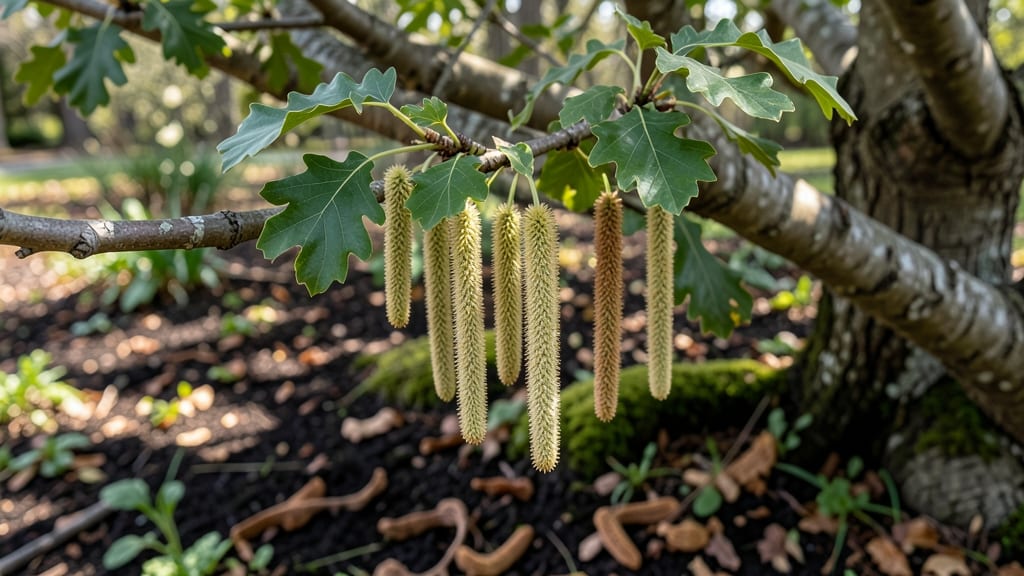
Oak tree pollen tassels appear in early spring as dangling, catkin-like clusters that signal the tree’s reproductive cycle. These fuzzy, yellowish strands release pollen to fertilize female flowers, typically between March and May depending on the oak species and climate.
These distinctive oak tree pollen tassels—often called catkins—are nature's way of preparing for reproduction. 🌳 The male flowers produce these fuzzy clusters to catch wind currents and disperse pollen efficiently, while female flowers develop tiny, less noticeable blooms.
Unlike many trees, oaks rely heavily on wind pollination, which is why you'll see these tassels swaying dramatically even in light breezes. Understanding their purpose helps explain why oak pollen allergies peak during this season, as the trees release massive amounts of pollen into the air.
Timing varies by species and region, but most oaks follow this pattern: red oaks pollinate first (February-March), followed by white oaks (March-April). The exact window depends on local climate—warmer winters can trigger earlier blooming, while cold snaps may delay the process.
This seasonal variation is why allergy sufferers often experience symptoms at different times depending on their location.
💡 In This Article
- What Causes Oak Tree Pollen Tassels to Form
- Managing Oak Tree Pollen for Allergies and Landscaping
What causes oak tree pollen tassels to form
The formation of oak tree pollen tassels begins with hormonal signals triggered by seasonal changes. As daylight hours increase in late winter, oak trees produce auxin hormones that stimulate bud development. These buds eventually grow into the familiar catkins—long, dangling clusters that contain male flowers.
The process is tightly regulated by temperature cues; most oaks require consistent daytime temperatures above 50°F for several weeks to initiate flowering.
Environmental factors play a critical role in timing and abundance. For example, red oaks often produce more pollen tassels than white oaks due to their earlier bud break—typically 2-4 weeks ahead of their white oak relatives.
Rainfall patterns also matter: too much moisture can delay tassel development, while dry spells may concentrate pollen production. The fuzzy texture of these catkins isn't accidental—it creates surface area for wind capture, allowing pollen grains to detach more easily and travel farther.
What most people don't realize is that oak trees have evolved this system to maximize reproductive success. Each tassel contains thousands of individual flowers, each producing pollen grains that are 20-30 microns in diameter—small enough to stay airborne for hours.
The timing coincides with when female flowers are receptive, creating a biological window where cross-pollination is most efficient. This is why oak pollen allergies peak during this period: trees release massive quantities of pollen over just 2-4 weeks.
Interestingly, the abundance of tassels can vary dramatically from year to year. In mast years (every 2-5 years), oaks produce 50-100% more pollen than average to overwhelm predators and ensure survival of offspring.
This phenomenon is linked to complex ecological cycles where multiple oak species synchronize their reproductive efforts. The result? A temporary but intense pollen explosion that can make allergy seasons particularly severe.
For gardeners and landscapers, understanding these triggers helps predict pollen seasons. If you notice tassels appearing earlier than usual, it often signals warmer-than-average winters or milder springs. This knowledge becomes especially valuable when planning pollen control strategies or selecting oak varieties for low-allergen landscapes.
The key is recognizing that these tassels aren't just decorative—they represent a sophisticated biological strategy with measurable environmental consequences.
Here's what's actually happening at the cellular level: The oak's vascular system transports nutrients to developing buds, while specialized cells in the tassels begin producing pollen mother cells.
These cells undergo meiosis to create haploid pollen grains, which then mature and are released through small pores in the tassel's surface. The entire process from bud formation to pollen release typically takes 4-6 weeks, making precise timing crucial for successful pollination.