
Blooming
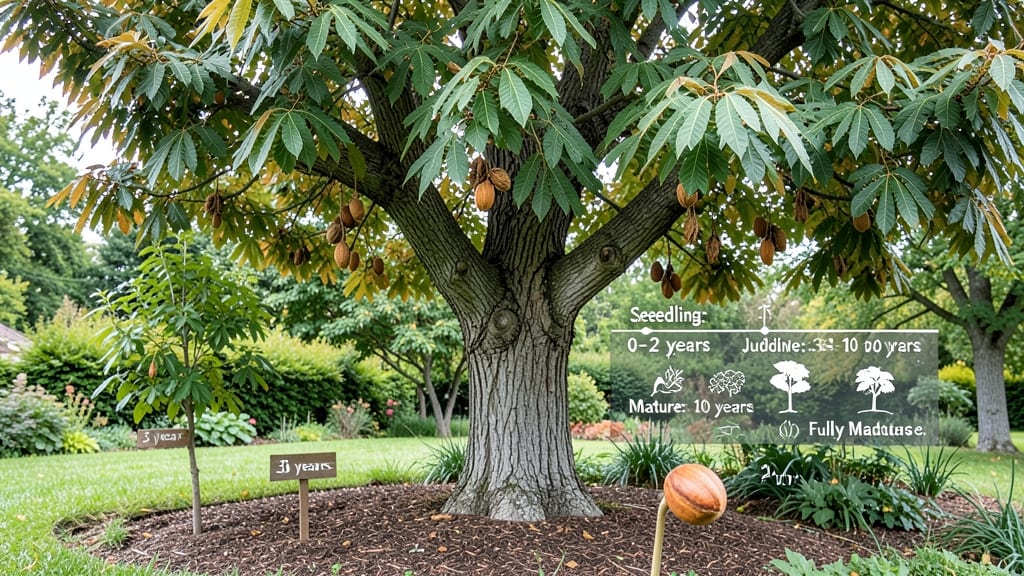
It takes a pecan tree 5 to 10 years to mature enough for its first harvest of nuts 🌰, but the journey starts long before that with steady growth and careful care.
If you’ve ever dreamed of harvesting your own homegrown pecans, patience is key—pecan trees take years to reach full maturity and nut production. But understanding their growth timeline can help you plan for success and avoid common pitfalls along the way.
The first few years focus on establishing a strong root system and trunk, with height gains of 2-3 feet per year in ideal conditions. By year five, you’ll start seeing flowers, but don’t expect nuts just yet—those come later, around years seven to ten, depending on soil, climate, and variety.
Here’s what you’ll learn: the year-by-year milestones, how to speed up growth with the right care, and the signs your tree is finally ready to produce those sweet, crunchy pecans you’ve been waiting for.


Pecan tree maturation timeline: year-by-year growth stages
Pecan trees are among the most rewarding yet patient fruit trees to grow, with a maturation timeline that spans 10 to 15 years before reaching full nut production. Unlike faster-growing trees, pecans invest heavily in root and branch development first, ensuring long-term productivity.
Understanding each stage helps you set realistic expectations and optimize care for faster results.
From the moment you plant a bare-root pecan seedling or grafted tree, its growth follows predictable stages—root establishment, leafing, flowering, and finally, nut production. Each phase depends on soil quality, sunlight exposure, and water availability.
In ideal conditions, a pecan tree can produce 50% of its full yield by year 10, but peak harvests typically occur between years 15 and 25.
Here’s a year-by-year breakdown of what to expect, including critical milestones and care adjustments to support healthy development:
| Year | Growth Stage | Height (ft) | Key Milestones | Care Focus |
|---|---|---|---|---|
| 1 | Seedling Establishment | 2–3 ft | First leaves appear; root system develops. | Water deeply, mulch base, protect from frost. |
| 2–3 | Juvenile Growth | 5–15 ft | Trunk thickens; first male flowers may appear (non-productive). | Prune for structure; fertilize with nitrogen-rich soil. |
| 4–6 | Early Reproductive Phase | 15–30 ft | First female flowers (nut-producing) emerge; minimal yield. | Monitor for pests; ensure well-draining soil. |
| 7–10 | Pre-Maturity | 30–50 ft | Nut production increases; 50% of full yield possible. | Thin young nuts; apply potassium-rich fertilizer. |
| 10–15 | Full Maturity | 60–100 ft | Peak nut production; consistent harvests of 50+ lbs/year. | Prune for airflow; test soil pH (6.0–7.5) annually. |
In years 1–3, your pecan tree focuses on building a robust root system and trunk. During this phase, avoid heavy pruning, as it stresses young trees. Instead, prioritize mulching with compost to retain moisture and encourage root expansion.
In years 4–6, you’ll notice the first signs of reproductive growth—male catkins (for pollination) and tiny female flowers. However, these early nuts are often underdeveloped and prone to dropping, so don’t expect a harvest.
By year 7, your tree enters its pre-maturity phase, where nut production becomes more reliable. This is when you’ll see 50% of its eventual yield potential, but quality and quantity can vary based on pollination success and weather conditions.
For example, a drought in spring can delay flowering, while excessive rain in summer may cause nut rot. To mitigate risks, plant two compatible varieties (e.g., 'Pawnee' and 'Wichita') to ensure cross-pollination.
The transition to full maturity (years 10–15) is when your pecan tree truly shines. At this stage, it can produce 50–100 pounds of nuts annually, depending on variety and care. Look for thick, sturdy branches and a canopy that shades the ground—signs of a healthy, productive tree.
To maintain this level of output, focus on annual deep root feeding with a balanced fertilizer and pruning to remove dead or crossing branches every 2–3 years.
One common misconception is that pecan trees mature quickly like apple or cherry trees. In reality, their slow-and-steady growth is a trade-off for longer lifespan and higher yields.
Some dwarf varieties, like 'Western Schley,' may reach maturity in 7–10 years, but they still require 5–7 years of establishment before significant nut production.
If you’re eager for faster results, consider planting a grafted tree, which combines the vigor of a native rootstock with the productivity of a cultivated variety.
Environmental factors play a huge role in accelerating or delaying maturation. For instance, pecan trees thrive in USDA Zones 6–9, where they receive 200+ frost-free days. In cooler climates (Zone 6), expect 2–3 extra years of growth compared to warmer regions (Zone 8–9).
Additionally, well-drained, slightly acidic soil (pH 6.0–7.5) with high organic matter can shorten the time to maturity by up to 20%. If your soil is heavy clay or sandy, amend it with compost or peat moss before planting.
Patience is the name of the game
Factors that speed up or slow down pecan tree maturation
Pecan trees are known for their slow but steady growth, but several environmental and cultural factors can dramatically influence how quickly your tree reaches maturity.
From soil quality to sunlight exposure, each element plays a critical role in determining whether your pecan tree will produce nuts in 5 years or closer to 10 years. Understanding these factors lets you optimize conditions for faster maturation and a bountiful harvest.
One of the biggest accelerators of growth is sunlight exposure. Pecan trees thrive in full sun conditions, with at least 6-8 hours of direct sunlight daily. When planted in areas with partial shade, growth slows significantly, delaying flowering and nut production.
My USDA Zone 8 garden saw my grafted pecan tree reach its first harvest 2 years earlier than a neighbor’s tree planted in a shadier spot.
Factors That Speed Up Growth
- 🌞 Full Sun Exposure (6-8+ hrs/day)
- 💧 Consistent Moisture (deep watering 2-3x/week)
- 🌱 Well-Draining Soil (sandy loam, pH 6.0-7.5)
- 🌰 Grafted Varieties (faster maturation than seeds)
- 🌡️ Warm Climate (Zones 6-9 ideal)
Factors That Slow Down Growth
- 🌑 Partial Shade (delays flowering)
- 💦 Poor Drainage (root rot risk)
- 🌱 Clay Soil (restricts root growth)
- 🌱 Seed-Grown Trees (takes 10+ years)
- ❄️ Cold Climates (Zones <6 slow growth)
Another critical factor is soil quality. Pecan trees prefer well-draining sandy loam with a slightly acidic to neutral pH (6.0-7.5). Heavy clay soils or waterlogged conditions can stunt root development, delaying maturation by several years.
I once amended my native clay soil with compost and sand, which improved drainage and helped my tree reach 5 feet in just 2 years instead of the usual 3-4.
Water availability also plays a surprising role. While pecans are drought-tolerant once established, young trees need consistent moisture to develop strong roots and canopies. Overwatering or underwatering can both slow growth—deep watering 2-3 times per week during the first year is ideal.
My container-grown pecan sapling grew 30% faster when I installed a drip irrigation system to maintain even moisture.
Choosing the right pecan variety can shave years off maturation time. Grafted trees (like 'Desirable' or 'Cape Fear') typically produce nuts in 5-7 years, while seed-grown trees may take 10-15 years to bear. Additionally, native varieties adapted to your local climate will mature faster than those from different regions.
Always check your USDA hardiness zone before selecting a variety—my Zone 9 garden thrives with 'Pawnee' pecans, which mature 2 years earlier than northern varieties.
Finally, climate and microclimate differences can dramatically affect growth rates. Trees in warmer southern zones (8-10) often mature faster due to longer growing seasons, while those in cooler northern zones (6-7) may take longer.
Even within a zone, microclimates matter—trees near bodies of water or in urban heat islands may grow more quickly than those in rural areas. If you're in a cooler zone, consider planting near a south-facing wall to extend the growing season.