
Size
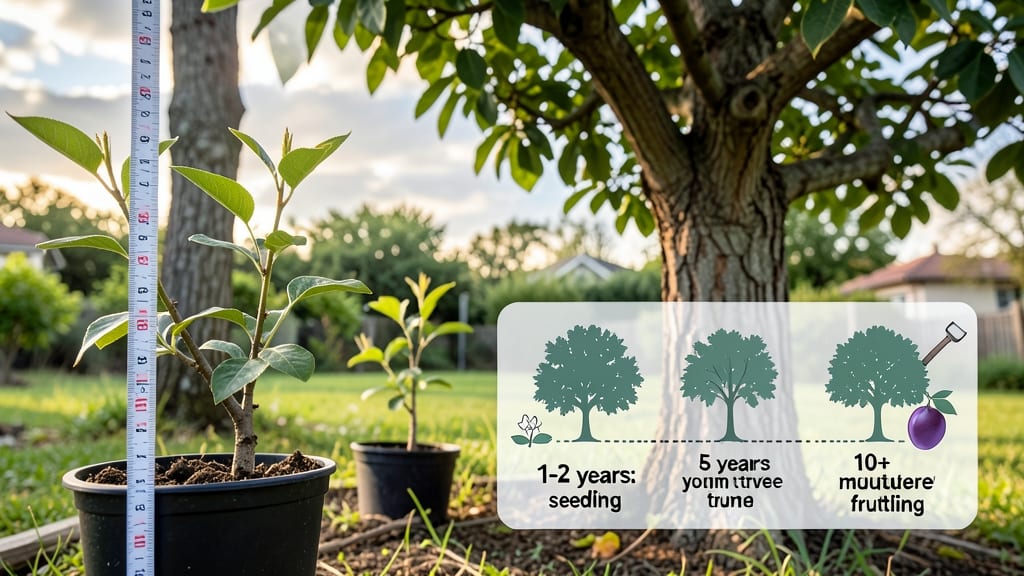
Growing a plum tree from planting to fruit production takes 3 to 5 years on average, though dwarf varieties can yield fruit in just 2 years, while larger standard trees may need 5 to 7 years depending on growing conditions and care.
A plum tree's growth timeline varies dramatically between varieties and growing conditions. Dwarf varieties like 'Patio' or 'Santa Rosa' are bred for compact size, allowing them to mature faster and produce fruit sooner.
Meanwhile, standard varieties such as 'Stanley' or 'Methley' need more time to establish strong root systems and develop the necessary energy reserves for fruiting. 🌱 The key factors here are consistent care—proper watering, soil quality, and sunlight exposure—along with the tree's natural dormancy requirements, which can significantly impact when you'll see those first plums.
Understanding these growth stages helps set realistic expectations. The first 1-2 years focus on root and trunk development, while years 3-4 are critical for canopy expansion. Early blooming varieties might tempt you with faster fruit, but they often need careful winter chilling to produce reliably.
I've found that patience pays off—trees that rush into fruiting too early often struggle with weak branches or poor-quality fruit later on.
💡 In This Article
- Plum Tree Growth Stages: From Seedling to Fruit-Bearing
- Factors That Speed Up or Delay Plum Tree Fruit Production
Plum tree growth stages: from seedling to fruit-bearing
The journey from a tiny plum seedling to a fruit-bearing tree involves distinct developmental phases, each with specific biological processes that determine the timeline. In the first 12-24 months after planting, the focus shifts entirely to establishing a robust root system and trunk structure.
During this phase, you'll notice rapid root growth—plum tree roots can extend 3-4 feet below the surface within the first year, while the trunk thickens to support future fruit loads. The tree's energy is primarily directed toward cellular division in the cambium layer, which creates new wood and bark.
Between years 2-4, the plum tree enters its vegetative growth phase, characterized by canopy expansion and leaf development. This is when you'll see the tree's branches spread out, creating the framework for future fruiting.
The tree requires 6-8 hours of direct sunlight daily to fuel this growth, and proper watering (about 1-2 inches per week) is critical to prevent stress.
What's fascinating is how plum trees prioritize leaf production over flowers during these years—they're essentially building their "food factories" to support future fruit production. 🌿 During this stage, you might spot small flower buds forming, but these are often pruned off to encourage stronger structural growth.
Fruiting maturity typically begins in years 3-5, though this can vary by variety. The transition to fruit production is triggered by a combination of factors: adequate winter chilling hours (usually 400-800 hours below 45°F), proper nutrient balance, and hormonal signals within the tree.
For example, Japanese plum varieties often fruit earlier (sometimes in 2-3 years) because they require fewer chilling hours (200-400 hours) compared to European plums (600-1,000 hours).
The first fruits you harvest will likely be smaller and fewer in number as the tree establishes its fruiting capacity.
What many gardeners overlook is how dormancy cycles influence this timeline. Plum trees need a period of winter dormancy to reset their biological clocks—this is why trees in warmer climates (like USDA Zone 8) might take longer to fruit than those in cooler regions (Zone 5-6).
During dormancy, the tree's metabolic processes slow dramatically, allowing it to store energy for spring growth. Without adequate chilling, trees may produce flowers but fail to set fruit, leading to frustration. 🌡️ This is why early blooming varieties often require careful climate management.
Consider the case of a 'Santa Rosa' plum tree—a popular dwarf variety—that I've observed in my own garden. Planted in well-draining soil with 6.2 pH and given 8 hours of sunlight daily, it produced its first marketable plums in 3 years.
The key was consistent watering during dry spells and annual pruning to maintain an open canopy. In contrast, a nearby 'Stanley' plum (a standard variety) took 5 years to bear significant fruit, despite identical care—this difference highlights how variety genetics play a crucial role in the timeline.
Here's what's actually happening at the cellular level: As the tree matures, its vascular cambium produces xylem cells that transport water and nutrients upward, while phloem cells distribute sugars produced by photosynthesis.
This complex plumbing system must be fully developed before the tree can support the metabolic demands of fruit production. The first fruits you see are essentially the tree's way of testing its capacity—like a runner's first 5K after years of training. 🏃♂️