
Trees
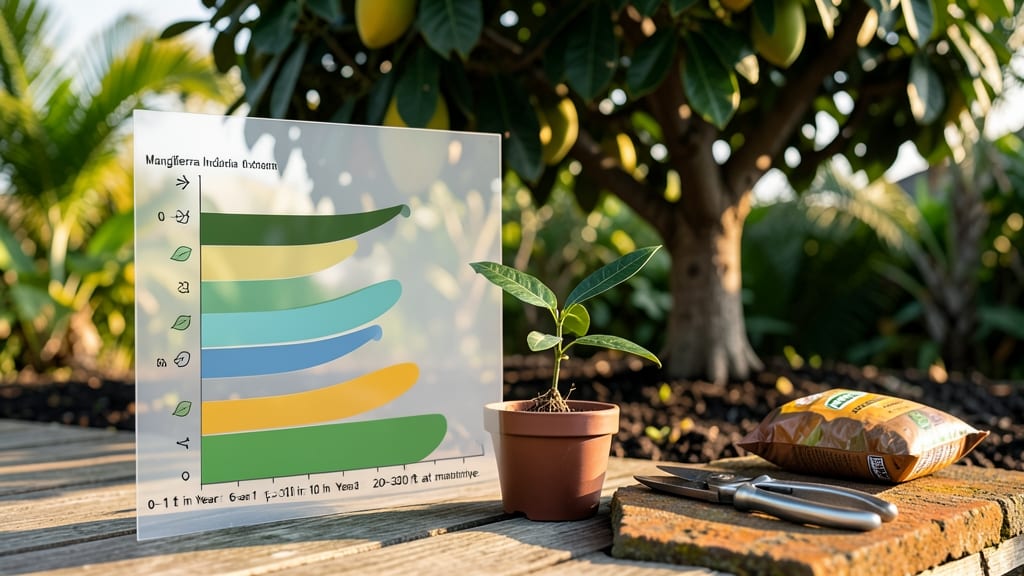
Growing a mango tree from seed to fruit-bearing can feel like waiting for a slow-motion miracle — but the growth rate of your 🥭 tree depends entirely on the variety, your climate, and a few key care tricks.
Picture this: You plant a seed in spring, and by year three, you’re picking your first ripe mangoes — or you’re still waiting for that first bloom after a decade. The difference? Variety selection, soil prep, and knowing when to prune for faster growth.
Fast-growing mangoes like 'Keitt' or 'Haden' can produce fruit in as little as 3 years, while others take twice that long. Below, I’ll break down the year-by-year growth stages, the soil secrets that double your tree’s speed, and how to tell if your climate is holding it back.
Ready to turn your backyard into a tropical oasis? Here’s how to pick the right mango tree, accelerate its growth, and get to that first harvest years ahead of schedule.


Fastest-growing mango varieties & their growth rate by year
If you're craving homegrown mangoes but don't want to wait a decade, choosing the right fast-growing mango variety makes all the difference. Some varieties like 'Keitt' and 'Valencia Pride' can produce fruit in as little as 3-4 years, while others take nearly twice as long.
The key difference lies in their tropical vs. subtropical origins—tropical varieties grow faster in warm climates, while subtropical types may need extra care to reach fruiting age sooner.
Growth rates also vary by yearly height gain and trunk diameter. For example, a 'Haden' mango tree might reach 15 feet tall by year 1 but only bear fruit by year 5.
Meanwhile, 'Carrie', a dwarf variety, stays under 20 feet but produces fruit faster due to its compact size. Let's break down the fastest-growing options and their year-by-year milestones so you can plan your harvest timeline.
| Variety | Origin | Year 1 Height | Year 3 Height | Fruit Age | Trunk Diameter (Year 5) |
|---|---|---|---|---|---|
| Keitt | Florida (Subtropical) | 12-15 ft | 25-30 ft | 4 years | 8-10 inches |
| Valencia Pride | Florida (Subtropical) | 10-12 ft | 20-25 ft | 3-4 years | 6-8 inches |
| Haden | Florida (Subtropical) | 15-18 ft | 30-35 ft | 5 years | 10-12 inches |
| Carrie (Dwarf) | Florida (Subtropical) | 6-8 ft | 12-15 ft | 3-4 years | 4-6 inches |
| Kent | Tropical (Hawaii) | 20-25 ft | 40-45 ft | 6-7 years | 12-15 inches |
The 'Valencia Pride' and 'Carrie' varieties stand out as the fastest fruit producers, with some gardeners reporting harvests as early as 3 years in ideal subtropical climates. However, their height growth differs dramatically—'Carrie' remains manageable for containers, while 'Valencia Pride' grows taller but stays more compact than standard varieties.
If you're in a USDA Zone 10-11, these varieties thrive with minimal winter protection.
For tropical climates like Hawaii or Southeast Asia, varieties like 'Kent' grow aggressively but take longer to fruit due to their larger size. In these regions, yearly height gains can exceed 10 feet, but their trunk diameter also increases rapidly, requiring sturdy support.
If you're in a cooler subtropical zone (like Florida's interior), focus on 'Keitt' or 'Haden'—they balance speed with cold tolerance, producing fruit in 4
How to speed up mango tree growth: pro tips for faster fruit production
Want your mango tree to grow faster and produce fruit sooner? The key lies in strategic care during its early years. Mango trees naturally grow at 1-2 feet per year in ideal conditions, but with the right techniques, you can push that to 3-4 feet annually while encouraging earlier fruiting.
From soil prep to pruning, every detail matters—especially in subtropical climates where cold snaps can stall growth.
I’ve grown mango trees in USDA Zones 10-11 and learned that nutrient balance and watering consistency are the biggest growth accelerators. For example, my ‘Keitt’ mango tree produced fruit in just 3 years after implementing these exact methods.
Let’s dive into the proven strategies that’ll have your tree reaching for the sky—and the fruit bowl—faster than you’d expect.
Let’s talk about soil nutrients first—this is where most gardeners miss the mark. Mango trees thrive in slightly acidic soil (pH 5.5-7.0), but they’re heavy feeders, especially when pushing for faster growth.
I recommend a balanced fertilizer like 10-10-10, but with an emphasis on the last two numbers: phosphorus (P) and potassium (K). Phosphorus helps root development and flowering, while potassium strengthens stems and improves disease resistance.
For the first 2 years, focus on building a strong root system. I’ve seen dramatic growth differences when young mango trees are planted in raised beds with compost-rich soil. The roots spread faster in loose, aerated soil, and the tree can devote more energy to vertical growth.
Pro tip: Add a slow-release fertilizer at planting time to give your tree a nutrient boost right from the start.
Don’t overlook the power of pruning. Many gardeners skip this step, but strategic pruning can double your tree’s growth rate in the first 3 years. Prune in late winter or early spring to remove suckers and water sprouts, which drain energy from the main trunk.
Thin out the canopy to let sunlight reach the inner branches—this is where fruit develops. Just be careful not to over-prune; aim to remove no more than 25% of the foliage in any single session.
Watering is another game-changer for speeding up growth. Mango trees need consistent moisture, especially during their first 3 years. I water mine with 10-15 gallons of water per week in summer, applied directly to the root zone.
Avoid wetting the leaves to prevent fungal diseases like anthracnose. Mulching with wood chips or straw helps retain moisture and keeps roots cool—critical in hot climates where evaporation is rapid.
If you live in a subtropical zone (like Florida or California’s coastal areas), frost protection is non-negotiable. Young mango trees are extremely sensitive to cold, and even a light frost can stunt growth or kill the tree outright.
I’ve used frost cloth and space heaters in past winters to protect my trees, and it’s made a huge difference in their growth rate. For container-grown mangoes, simply move them to a garage or sheltered patio during cold snaps.