
Pruning
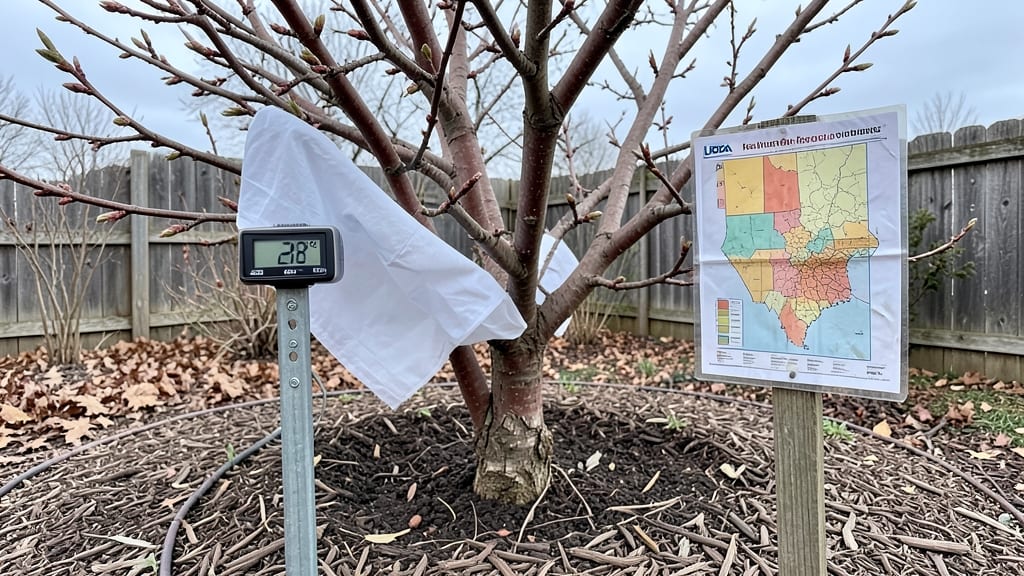
Understanding peach tree cold tolerance is key to growing thriving trees in colder climates, as most varieties handle temperatures down to -10°F to -15°F (-23°C to -26°C) but suffer in prolonged freezes. Strategic winter care—like mulching and trunk protection—can significantly improve their survival rates in marginal zones.
Peach trees aren't built for Arctic winters, but with the right preparation, they can survive—and even thrive—in USDA Zones 5-9.
The secret lies in their chilling requirements: most varieties need 400-800 hours below 45°F to set fruit properly, which is why they struggle in warmer climates too. 🌡️ I've seen gardeners in Zone 5 double their success rates by combining winter mulching with reflective barriers to trap heat near the roots.
Even a few degrees difference can mean the difference between a thriving orchard and winter dieback.
What's often overlooked is how microclimates affect cold tolerance. A south-facing slope or a windbreak can add 5-10°F of protection to your tree's environment, potentially pushing its cold hardiness into Zone 4 territory.
I always recommend planting near structures or using evergreen windbreaks to create these protected zones—it's one of the simplest ways to extend your growing range without sacrificing fruit quality.
💡 In This Article
- USDA Zones for Peach Trees: Cold Hardiness by Variety
- Winterizing Peach Trees: Mulching, Pruning, and Protection Techniques
USDA zones for peach trees: cold hardiness by variety
Peach trees aren't created equal when it comes to cold tolerance—some varieties can handle -15°F (-26°C) while others start showing damage at 20°F (-7°C). The 'Reliance' variety, for example, is one of the hardiest, surviving down to -20°F (-29°C) with proper winter care, making it ideal for Zone 5 gardens.
In contrast, the popular 'Redhaven' peach typically maxes out at -10°F (-23°C), struggling in Zone 4 winters. This difference comes down to their genetic origins—Northern European peach hybrids like 'Reliance' were bred specifically for colder climates.
The science behind this tolerance involves how quickly a tree's cells dehydrate in freezing temps.
Hardier varieties produce more antifreeze proteins that prevent ice crystal formation in their vascular system, similar to how some fish survive Arctic waters. 🌡️ For instance, a 'Contender' peach tree (Zone 5-6) can withstand -20°F (-29°C) because its cells maintain flexibility through a process called supercooling.
Meanwhile, Southern varieties like 'Elberta' (Zone 6-9) lack these adaptations and often suffer bark splitting at 15°F (-9°C).
Chilling hours play an equally critical role in winter survival. Most peach trees require 400-800 hours below 45°F (7°C) annually to break dormancy properly—a threshold that's difficult to meet in milder climates like Southern California.
This is why you'll rarely see productive peach orchards in Zone 9 without supplemental chilling techniques. In colder zones, the extended winter provides these hours naturally, but gardeners in marginal zones (like northern Zone 5) must balance cold hardiness with adequate chilling to ensure fruit set.
What most people don't realize is that cold tolerance isn't static—it fluctuates based on tree age and health. Young peach trees (under 3 years old) are more vulnerable to cold damage because their bark is thinner and their root systems aren't fully established.
A 5-year-old 'Montgomery' peach (Zone 5-6) might survive -25°F (-32°C) with protection, while a 2-year-old sapling of the same variety could suffer dieback at -15°F (-26°C). This is why nurseries often recommend waiting until trees are 2-3 years old before exposing them to Zone 5 winters.
For gardeners pushing peach trees into Zone 4, consider these variety-specific strategies: Plant 'Reliance' or 'Contender' near south-facing walls where winter sun can raise soil temps by 3-5°F.
These varieties also benefit from delayed pruning—waiting until late winter to remove dead wood, which gives the tree extra time to harden off naturally. In contrast, Southern varieties like 'Loring' (Zone 6-9) should never be planted in Zone 4 without advanced protection like heated root zones or underground insulation.
Here's a quick reference for common peach varieties and their cold limits:
- 'Reliance': -20°F (-29°C) with protection (Zone 4-6)
- 'Contender': -20°F (-29°C) (Zone 5-6)
- 'Montgomery': -15°F (-26°C) (Zone 5-6)
- 'Redhaven': -10°F (-23°C) (Zone 6-9)
- 'Elberta': 15°F (-9°C) (Zone 6-9)
Remember: These are maximum tolerances under ideal winter conditions. Prolonged exposure to temps below a variety's limit—even by 1-2°F—can lead to bark cracking, which is often fatal. 💫