
Size
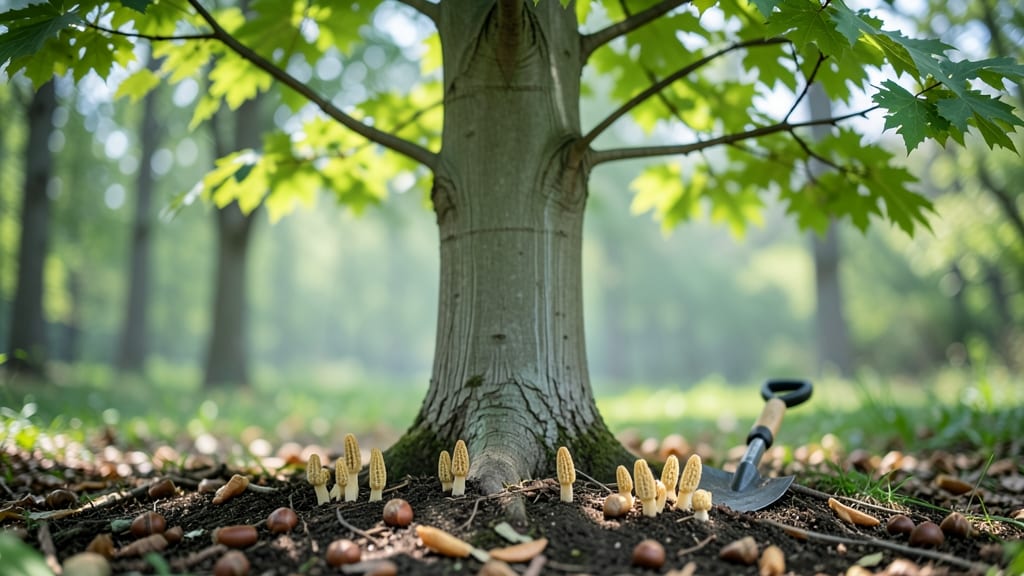
Morel mushrooms grow by dead or dying elm and ash trees, creating their ideal habitat in decaying wood that's rich in cellulose and nutrients. These fungi seek out moist, shaded forest floors near rotting logs or stumps.
Morels have a fascinating relationship with these trees because their mycelium thrives in the warm, damp conditions created by decomposing wood. 🌲 The decaying elm and ash provide both shelter and the nutrients morels need to fruit, especially during spring's mild temperatures.
Unlike other mushrooms that spread spores widely, morels form these distinctive honeycomb caps right at the base of their host trees, often appearing within weeks of the first spring rains.
What's interesting is that morels rarely grow on healthy trees—they specifically target weakened or dead specimens where the wood has started breaking down. This makes them excellent indicators of forest health, as their presence suggests a natural cycle of decay and regeneration.
Foragers often look for trees with cracked bark or white fungal growth at their base, as these are classic signs of morel-friendly conditions.
💡 In This Article
- Why Elm and Ash Trees Attract Morel Mushrooms
- How to Identify Morel-Friendly Dead Trees in Forests
Why elm and ash trees attract morel mushrooms
Morels have a symbiotic relationship with decaying elm and ash trees because these hardwoods create the perfect microclimate for fungal growth. As the trees die, their cellulose-rich wood breaks down through microbial action, raising soil temperatures to an ideal 50-70°F range while maintaining high moisture levels—both critical for morel development.
The decomposition process releases nutrients like nitrogen and phosphorus that morels absorb through their mycelium network.
The key lies in how these trees decompose differently than others. Elm and ash wood contains higher levels of tannins and lignin, which create a slower decay process that maintains the moist, shaded conditions morels crave.
You'll often find morels growing in clusters near the base of trees where the bark has started to slough off, revealing the spongy, white mycelium beneath. This fungal network can extend up to 10 feet underground, waiting for the right conditions to fruit.
What makes this relationship so precise is that morels rarely grow on healthy trees—they specifically target weakened specimens where the wood has begun breaking down. The decaying process creates a warm, humid environment that mimics the conditions of a forest floor in early spring, when morels typically emerge.
This is why you'll often see them popping up within 2-4 weeks after the first significant spring rains, when the soil temperature reaches 55°F consistently.
There's also a chemical aspect to consider. The decomposition process produces volatile organic compounds that signal to morel spores it's time to fruit. These compounds create what mycologists call an "aromatic cue" that triggers the growth of the characteristic honeycomb caps.
The combination of physical structure (decaying wood) and chemical signals makes elm and ash trees the perfect partners for morel cultivation in nature.
Interestingly, this relationship benefits the forest ecosystem. As morels break down the wood further, they help accelerate nutrient cycling, returning vital minerals to the soil.
This creates a feedback loop where the forest's natural decay processes are enhanced by the presence of these fungi, making them more than just a delicacy—they're essential participants in woodland regeneration.
For those interested in foraging, understanding this relationship means you're not just looking for dead trees—you're seeking specific decay stages. The ideal tree will have partially decomposed wood with visible fungal growth at its base, often accompanied by a musty, earthy aroma that's unmistakable to experienced foragers.
This sensory clue, combined with the visual cues of cracked bark and moist soil, creates the perfect hunting ground.